
WELCOME BONUS 300%
UP TO €2000 + 100
FREE SPINS
UP TO €2000 + 100
FREE SPINS
Home → Blackjack
Blackjack at Go Go Gold Casino: Variants, Rules and Payouts
Surrender or Play On With 16 Against a 10
Late surrender returns half the stake after the dealer has checked for blackjack, and it improves the return by about 0.08 percentage points. That figure looks small next to the headline numbers, yet it is a permanent rule effect rather than a one-off payout. Early surrender is worth far more, up to 0.6 percentage points, but it is extremely rare at live tables. On a €10 bet the surrendered hand costs €5, while playing the hand out against a dealer 10 risks the full stake.
Against a dealer 10, a hard 16 wins only when the dealer busts, and standing on 16 versus a 10 leaves the player well below a break-even return. The main reference line for the same table is six-deck blackjack with S17, DAS and DOA at an RTP of 99.54% and a house edge of 0.46%. Insurance is never part of this decision, because a 10 is not an ace and the side bet cannot be taken.
The comparison to keep in mind is a blackjack paid at 3:2 against one paid at 6:5. On a €10 stake the first pays €15 and the second pays €12, so the weaker payout adds 1.39 percentage points to the casino's edge, more than any other single rule change. A player who surrenders a 16 against a 10 keeps half the stake instead of chasing that gap.
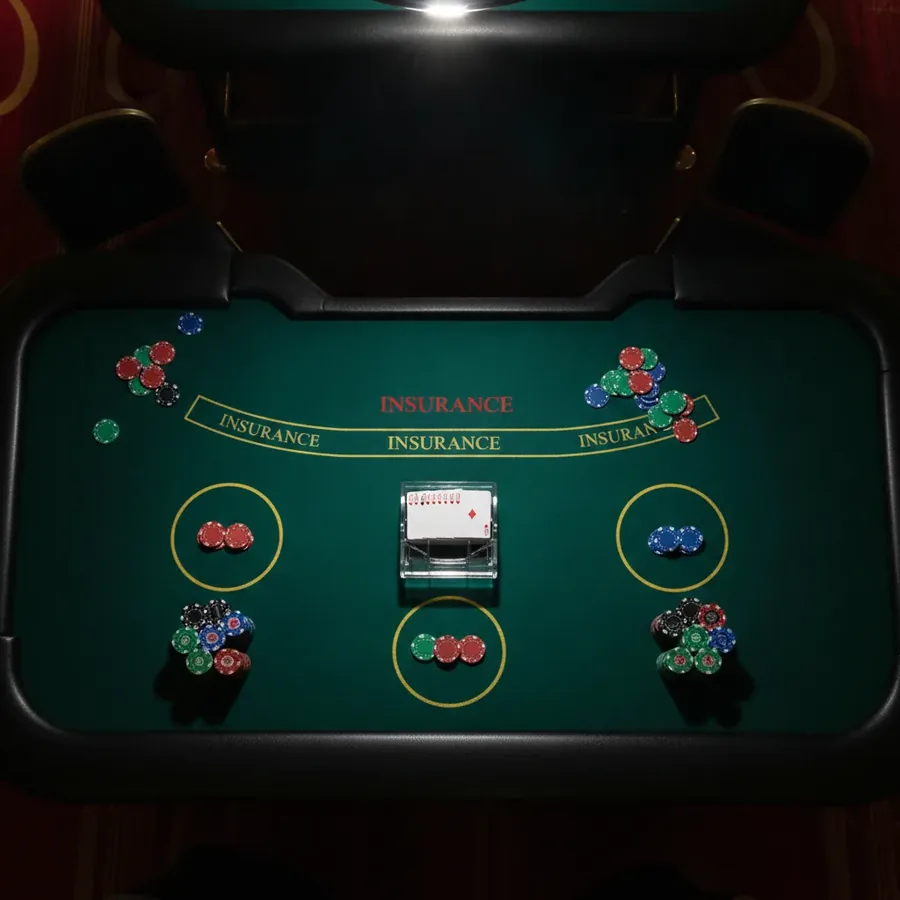
Splitting at a Live Table, Step by Step
Doubling after a split improves the return by about 0.14 percentage points, and resplitting aces adds roughly 0.08 percentage points. Both figures come from the same six-deck S17, DAS, DOA reference game with an RTP of 99.54% and a house edge of 0.46%. The rules allow a split into as many as four hands, with split aces usually receiving one card each.
Infinite Blackjack from Evolution runs at an RTP of 99.47% with unlimited seats and four side bets: Any Pair, 21+3, Hot 3 and Bust It. Quantum Blackjack Plus Live from Playtech returns 99.57% with optimal strategy and carries multipliers up to 1,000x on three-card combinations worth 21 points. The bet range at Infinite Blackjack runs from €1 to €5,000, so a €100 split puts €200 on the table before any card is dealt.
The order of operations matters at the table. The player places the original bet, the dealer deals the first two cards, and the split is declared before any further cards are drawn. Each resulting hand is then played separately, and a double on either hand doubles that hand's stake with one card only. Blackjack Party from Evolution, with two hosts and a bet range of €1 to €1,000, follows the same mechanical sequence.
Splitting Eights vs Standing on 16
A pair of eights is the clearest split in the game, and the split rule set that allows doubling after the split is worth about 0.14 percentage points. Resplitting aces is worth roughly 0.08 percentage points, while six decks instead of eight is worth about 0.02 percentage points. Those three modifiers all sit inside the same six-deck S17, DAS, DOA reference game at 99.54% RTP and a 0.46% house edge.
Standing on 16 against a dealer 10 is a losing position in raw terms, and the same 16 split into two hands of eight gives each hand a live draw. The maximum is four hands, so the exposure can reach four times the original stake. On a €25 bet the full split into four hands commits €100, which is a different risk profile from standing.
Blackjack Single deck with classic rules and a 3:2 payout returns 99.85% with a house edge of just 0.15%, and that single-deck structure changes the arithmetic of the pair. Insurance pays 2:1 but lowers the long-run return, so it stays out of the split decision entirely. The player who splits eights is choosing the hand structure, not the payout ratio.
Soft 17 Hit vs Stand: 0.22 Percent
A dealer who hits soft 17 lowers the return by 0.22 percentage points, which is the largest single rule penalty in the reference set. Blackjack Liberal Vegas Strip uses S17 with DAS, resplit and late surrender, and it returns 99.72% with a house edge of 0.28%. The same game carries a standard deviation of 1.15.
The gap between the two rule sets is measurable. Six-deck S17, DAS and DOA returns 99.54%, while switching the dealer to hit soft 17 pushes the return down by 0.22 percentage points. Late surrender pulls in the opposite direction by about 0.08 percentage points, and doubling after a split adds roughly 0.14 percentage points. None of these modifiers reaches the size of the soft 17 change on its own.
For the player, the difference lands on every settled hand. On €100 of stakes the H17 rule costs about €0.22 more than the S17 version, and that cost is charged whether the hand is won or lost. Blackjack Insurance at 92.53% RTP with a 7.47% house edge is a separate side bet of up to 50% of the main bet, and basic strategy always declines it outside true count conditions.
Blackjack variants at a glance
| Variant | Payout | House edge | Rule | RTP |
|---|---|---|---|---|
| Blackjack Single deck, classic rules, 3:2 | Blackjack 3:2, win 1:1 | 0.15% | Fewer decks = lower edge; one deck gives about −0.48 percentage points compared with 8 decks. Often offset by a 6:5 payout. | 99.85% |
| Blackjack 6:5 payout instead of 3:2 (6 decks) | Blackjack 6:5, win 1:1 | 1.85% | Replacing 3:2 with 6:5 adds exactly +1.39 percentage points to the casino's edge – more than any other rule change. On a €10 bet a blackjack pays €12 instead of €15. | 98.15% |
| Blackjack 6 decks, S17, DAS, DOA, 3:2 payout, basic strategy | Blackjack 3:2, regular win 1:1, insurance 2:1 | 0.46% | Dealer stands on soft 17; double down on any first two cards; doubling after a split allowed; no surrender. Basic strategy is required to reach this figure | 99.54% |
| Blackjack Insurance (6–8 decks) | Insurance 2:1 | 7.47% | Separate side bet of up to 50% of the main bet when the dealer shows an ace. Basic strategy ALWAYS declines it (except for card counters at a true count ≥ +3). With a single deck the edge is ≈ 5.88% | 92.53% |
| Blackjack Split / double / H17 – rule effects | Double – stake ×2 with one card; split – up to 4 hands; split aces usually get one card each. | H17 +0.22 percentage points; RSA −0.08 percentage points; DAS −0.14 percentage points | Dealer hitting soft 17 lowers RTP by 0.22 percentage points; resplitting aces improves it by 0.08 percentage points; doubling after a split improves it by about 0.14 percentage points; 6 decks instead of 8 – about 0.02 percentage points. | n/a (rule modifiers) |
| Blackjack Liberal Vegas Strip (liberal rules, 3:2) | Blackjack 3:2, win 1:1 | 0.28% | The most player-friendly rule set: S17 + DAS + resplit + late surrender. Standard deviation 1.15 | 99.72% |
What a Natural Blackjack Actually Pays
A natural blackjack pays 3:2 under the standard six-deck rules, so a €100 stake returns €150, while the same hand at 6:5 pays only €120. The house edge of that six-deck game sits at 0.46% with an RTP of 99.54%, provided basic strategy is followed on every decision. A player who ignores basic strategy gives back part of that 99.54% over time, because the figure assumes correct play on each hand.
Replacing 3:2 with 6:5 adds exactly 1.39 percentage points to the casino's edge, pushing the house edge from 0.46% to 1.85% and dropping the RTP to 98.15%. That single rule change costs more than any other adjustment on the table. On a €10 bet the difference is €12 instead of €15 per natural, which is €3 less every time the hand lands.
Insurance is a separate side bet of up to 50% of the main bet when the dealer shows an ace, and it pays 2:1 but carries a house edge of 7.47% and an RTP of 92.53% across six to eight decks. Basic strategy always declines it, since the return is far below the 99.54% of the main game. Only card counters at a true count of at least +3 have a reason to take it, and that edge narrows to roughly 5.88% with a single deck.
Calling Late Surrender Correctly in Three Steps
Late surrender lets a player give up the hand after the dealer has checked for blackjack and lose half the stake, and it improves the RTP by about 0.08 percentage points on a six-deck game. The house edge therefore falls by 0.08 percentage points from the 0.46% baseline. Half of a €100 stake comes back as €50, so the cost of a bad hand is capped before the draw.
First, the dealer must check the hole card for blackjack; surrender is only available after that check, which separates it from early surrender. Second, the player folds the hand and receives 50% of the stake, not the full amount. Third, the decision must be made before any hit, split or double, since those actions close the surrender option.
Early surrender is worth far more, up to 0.6 percentage points, but it is extremely rare in practice. The liberal Vegas Strip rule set, which combines standing on soft 17, doubling after a split, resplitting and late surrender, reaches an RTP of 99.72% and a house edge of 0.28%. Against that, a rule set where the dealer hits soft 17 adds 0.22 percentage points to the edge, wiping out nearly three times the surrender gain.
The Shoe, the Cut Card and 75% Penetration
A six-deck shoe with a cut card placed to deal 75% of the cards before the shuffle leaves roughly 78 cards unseen at the end of each round cycle. Fewer decks tighten the game: one deck instead of eight lowers the house edge by about 0.48 percentage points. The six-deck baseline at 0.46% already reflects this effect, and moving from six to eight decks adds only about 0.02 percentage points.
Doubling after a split improves the RTP by about 0.14 percentage points, and resplitting aces adds another 0.08 percentage points. Both rules interact with penetration: the deeper the cut card sits, the more decisions a player faces per shoe. Doubling on any first two cards and splitting into up to four hands both depend on those extra rounds being dealt before the shuffle.
A single-deck game with classic rules reaches an RTP of 99.85% and a house edge of 0.15%, the lowest on the table, but the advantage is often offset by a 6:5 payout. At 6:5 the RTP falls to 98.15% and the edge rises to 1.85%, which more than cancels the single-deck gain of 0.48 percentage points. Penetration and deck count only pay off when the payout stays at 3:2.
Side Bets Raise the House Edge to 5%
Insurance is the clearest example of a side bet that raises the effective cost of play: it carries a house edge of 7.47% and an RTP of 92.53% across six to eight decks, against 0.46% and 99.54% for the main blackjack hand. The gap is 7.01 percentage points on every euro staked on the side bet. A €10 insurance bet therefore returns €9.25 on average, while the same €10 on the main hand returns €9.95.
Infinite Blackjack from Evolution offers four side bets, Any Pair, 21+3, Hot 3 and Bust It, alongside an RTP of 99.47% for the main game. The main-game figure sits close to the six-deck baseline of 99.54%, so the side bets are what move the overall cost. Each of the four is a separate wager with its own edge, and none of them is covered by the 99.47% figure.
Quantum Blackjack Plus Live from Playtech shows the opposite case: quantum multipliers up to 1,000x on three-card combinations worth 21 points support an RTP of 99.57% with optimal strategy. That figure is 0.03 percentage points above the six-deck baseline of 99.54%. The multiplier only applies when the three-card combination lands, so the base game still runs on the same 3:2 payout and 1:1 regular win.
Infinite Blackjack vs the Classic Seven-Seat Table
Infinite Blackjack from Evolution uses unlimited seats at the table with a bet range of €1 to €5,000, while a classic seven-seat table caps the number of players at seven. The RTP of 99.47% sits 0.07 percentage points below the six-deck baseline of 99.54%. The trade is seat availability against a slightly thinner return on every hand.
Blackjack Party from Evolution runs a bet range of €1.00 to €1,000 with two hosts, a much narrower spread than the €1 to €5,000 on Infinite Blackjack. Quantum Blackjack Plus Live from Playtech matches that €1 to €5,000 range and adds an RTP of 99.57% with optimal strategy. A player staking €100 a round on the six-deck game faces an average cost of €0.46 per hand at a 0.46% edge.
The seven-seat format limits how many hands are dealt per shoe, which matters when penetration reaches 75% of a six-deck shoe. Unlimited seats remove that ceiling but do not change the underlying edge: 99.47% against 99.54% is a difference of 0.07 percentage points, or €0.07 per €100 staked. Over 1,000 hands at €100 each, that gap amounts to €70.
Split Aces: Only One Card per Hand
A split aces rule in blackjack gives each ace exactly one additional card, so a pair of aces becomes two hands that cannot be hit again. Resplitting aces, by contrast, lowers the house edge by 0.08 percentage points and lets a further pair be divided, which is why the two versions of the rule are not interchangeable at the table.
Across the standard six-deck game with the dealer standing on soft 17, doubling allowed on any first two cards and doubling after a split permitted, the house edge sits at 0.46% and the RTP at 99.54%. Splitting aces without resplitting fits inside that 0.46% baseline, so the restriction costs the player the 0.08 percentage points that resplitting would have returned.
On a €10 stake, splitting aces into two hands puts €20 at risk, and each hand receives one card only. Resplitting aces would improve the return by about 0.08 percentage points, worth roughly €0.02 per €20 of split aces over the long run, so the rule mostly changes the shape of the hand rather than the price of it.
Doubling After a Split: Which Tables Allow It
Doubling after a split, known as DAS, improves the return by about 0.14 percentage points, and the liberal Vegas Strip rule set that combines S17, DAS, resplit and late surrender reaches an RTP of 99.72% with a house edge of 0.28%. That combination is the most player-friendly rule set on the blackjack list, and DAS is one of the four rules carrying it.
The six-deck game with S17, DAS, DOA and a 3:2 payout reaches 99.54% RTP and a 0.46% house edge, which is 0.18 percentage points weaker than the liberal Vegas Strip version. Doubling after a split accounts for roughly 0.14 of those points, so a table that forbids DAS charges the player close to that amount on every split hand they would otherwise double.
The double-down itself doubles the stake with one card, and a split can produce up to four hands. On a €10 bet, doubling after a split turns a single €10 commitment into €20 on that hand, and doing it across four split hands puts €40 on the felt once the split and the doubles are all funded.
When Can You Raise Your Bet?
The doubling rule in the six-deck game with S17, DAS and DOA allows a double on any first two cards, which is broader than the classic restriction to hard 9, 10 and 11. Basic strategy is required to reach the 99.54% RTP and 0.46% house edge that the table posts, so the freedom to double is only worth that figure when it is used correctly.
Insurance is a separate side bet of up to 50% of the main bet when the dealer shows an ace, and it pays 2:1. Basic strategy always declines it, and the insurance bet carries a 92.53% RTP with a 7.47% house edge, which is far below the 99.54% RTP of the main game, so increasing the bet through insurance costs the player money.
A split is the other moment the stake grows: the bet is matched to create a second hand, and up to four hands can result. On a €10 bet, splitting once commits €20, and a further double on each of two hands commits €40 in total, with the stake rising only at those rules-defined moments.
Split, Double Down and Surrender by the Numbers
Late surrender improves the return by about 0.08 percentage points, and the player gives up the hand after the dealer has checked for blackjack, receiving 50% of the stake back. Early surrender is worth up to 0.6 percentage points but is extremely rare, so the practical version of the rule is the late one that appears in the liberal Vegas Strip rule set.
The liberal Vegas Strip rule set combines S17, DAS, resplit and late surrender for an RTP of 99.72% and a house edge of 0.28%, with a standard deviation of 1.15. The six-deck S17, DAS, DOA game at 3:2 reaches 99.54% RTP and a 0.46% house edge, so surrender is part of the 0.18 percentage-point gap between the two rule sets.
Dealer hitting soft 17 costs 0.22 percentage points, resplitting aces returns 0.08, DAS returns about 0.14, and moving from eight decks to six is worth about 0.02. On a €10 bet, surrender returns €5 instead of the full stake, and the 0.08 percentage-point gain is measured across thousands of hands, not on a single decision.
Contact
Live - online chat
Banking









Providers












Go Go Gold Casino 2026